What is Foundgine?
Foundgine is the layer between application meaning and physical execution. Callers express intent; the application remains the authority.
The problem
Modern applications expose the same business data through multiple surfaces: APIs, GraphQL, automation, JSON, MCP and AI agents. If each surface builds its own validation, authorization and data-access path, the application accumulates duplicated security and execution logic.
The Foundgine model
Foundgine introduces one provider-independent semantic boundary. The semantic model describes what the application exposes; intent describes what the caller wants; authorization decides what the current trusted context may exercise; planning turns that decision into an executable form.
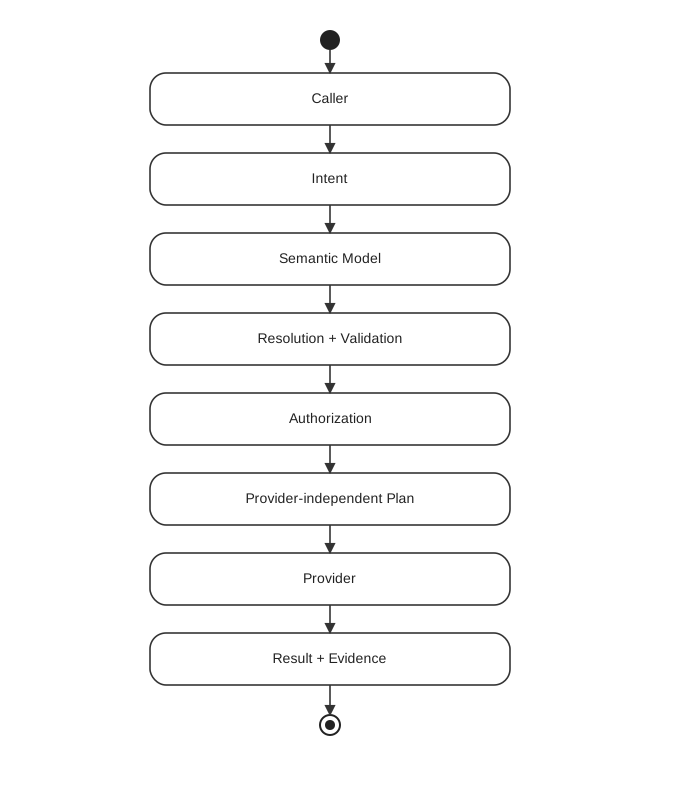
Semantic model versus persistence model
A persistence model describes storage. A semantic model describes application meaning. They can intentionally differ in fields, relationships, aliases and capabilities. This lets the application expose business concepts without making database structure its public contract.
Persistence model  →  how data is stored
Semantic model     →  what the application exposes
Intent             →  what the caller asks for
Authorization      →  what this trusted context may exercise
Why it matters for AI
An AI model can propose a useful operation without becoming the authority over database schema, tenant identity, credentials or business invariants. Capability discovery helps the model form valid intent; the server still resolves and authorizes the actual request.
This matters even more as the number of tools grows. Routing every capability through the same semantic and authorization boundary avoids creating a separate security surface for every tool.
What Foundgine is — and is not
| Foundgine is | Foundgine is not |
|---|---|
| Semantic execution boundary | ORM replacement |
| Provider-independent planning/runtime layer | Database |
| Application-controlled semantic authorization | Identity provider or authorization server |
| Execution substrate for multiple callers | General autonomous-agent framework |
| Capability surface for agents | Model provider |
Ambiguity is a result, not a silent guess
Free-form language can match more than one legal meaning. Retrieval scores are evidence, not truth. When two semantically distinct interpretations remain genuinely ambiguous, Foundgine can return a clarification requirement instead of authorizing the top-scored guess.
See Grounding decisions for the detailed model and Lexical grounding for the retrieval side.