Foundgine
Testing
Foundgine uses tests to protect architectural boundaries as well as individual APIs.
Run everything
dotnet test
Build first when diagnosing compilation failures:
dotnet build
dotnet test
Test layers
The repository contains tests for the major packages, including:
Abstractions
AOT / generator
Semantics
Metadata
Planning
Execution
SQL
InMemory
GraphQL
MCP
AI
Security.Authority
E2E
Exact test project names are visible under src/csharp/tests/.
What the tests should prove
Semantics
Test:
- entity/field/relationship resolution;
- invalid references;
- type/value validation;
- pagination validation;
- logical traversal expansion;
- immutable snapshots;
- authorization decisions;
- conditional predicates;
- mutation semantic graphs.
Planning
Test:
- plan topology;
- provider independence;
- authorization preservation;
- rewrite equivalence;
- aggregate legality;
- deterministic fingerprints;
- provider-cost selection.
Execution
Test:
- provider boundary;
- execution IR;
- security invariant gates;
- result materialization;
- evidence;
- plan caching;
- mutation dependency execution.
Providers
Test that a provider:
- compiles the logical plan correctly;
- preserves authorization;
- satisfies required security invariants;
- handles pagination;
- materializes the expected result.
Security tests
Security tests should assume transports are hostile.
Important cases include:
caller requests denied field
caller traverses denied relationship
caller tries to cross tenant boundary
caller supplies forged authority context
provider drops authorization predicate
cached plan loses runtime context
mutation executes without required approval/security proof
The expected result is rejection, not widened access.
PostgreSQL tests
PostgreSQL integration tests are separate from the database-free suite.
See POSTGRES-E2E.md.
Deterministic testing
Prefer tests that assert semantic/plan contracts rather than exact SQL formatting when the SQL text is not the behavior under test.
For provider tests, exact SQL assertions are appropriate where SQL generation itself is the subject.
Test the boundary, not implementation trivia
A strong Foundgine test generally follows:
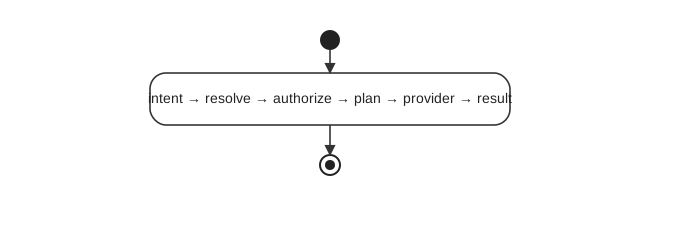
This is more valuable than testing an internal helper in isolation when the helper’s only purpose is to support the pipeline.
Regression discipline
When fixing a bug:
- add a focused failing test;
- fix the owning layer;
- run the affected package tests;
- run the full suite;
- run PostgreSQL E2E when the change crosses the SQL/provider boundary.
Do not fix a semantic bug inside a transport adapter merely because that is where the failure was first observed.
Next: Current status