Foundgine
Current status — Foundgine 2.2.1 (.NET & Java)
The repository ships two implementations of the same architecture, released together on a single aligned version line: the .NET implementation targets .NET 9, and the Java implementation targets Java 21 (Maven, groupId io.github.cristianbarragan). Except where noted below, everything on this page applies to both.
This page is intentionally short: it describes the current architectural state rather than preserving historical release notes.
Implemented architecture
The active source tree contains the following layers:

Around that core are:
Metadata
AOT / source generation
JSON
GraphQL
MCP
AI
Security.Authority
Current semantic capabilities
The semantic layer currently covers:
- semantic entities, fields, identities, relationships and aliases;
- typed and dynamic read intent;
- filters and logical filter composition;
- relationship filters and quantifiers;
- ordering and relationship-path ordering;
- limit/offset/cursor controls;
- semantic type/value validation;
- logical traversals;
- immutable semantic contract snapshots;
- semantic capability descriptions;
- entity/field/relationship authorization;
- read/write authorization;
- conditional authorization predicates;
- semantic mutation graphs;
- generated-value mutation dependencies;
- security execution context and warrant-related contracts.
Current planning capabilities
The planner currently provides:
- provider-independent read plans;
- separate mutation planning;
- authorization-preserving plan state;
- execution IR lowering;
- deterministic plan/fingerprint concepts;
- conservative rewrite rules;
- authorization canonicalization;
- predicate pushdown;
- safe projection pruning;
- relationship traversal/join ordering metadata;
- aggregate-related rewrites and safety gates;
- provider-aware advisory cost estimation.
Current execution capabilities
Foundgine.Core.Execution provides:
- provider compilation/execution contracts;
- execution IR;
- result materialization;
- execution evidence/receipts;
- provider security conformance;
- security-invariant execution gates;
- optional execution-time authorization revalidation;
- provider plan caching;
- mutation dependency/execution coordination.
Current providers
SQL
Foundgine.Providers.Storage.Sql (foundgine-providers / com.foundgine.providers.storage.sql in Java) provides the primary SQL implementation and PostgreSQL-specific functionality, including:
- parameterized SQL compilation;
- SQL execution through ADO.NET (.NET) or JDBC (Java);
- PostgreSQL retrieval candidate sources — relational,
Fuzzy(pg_trgm),FullText(tsvector), optionalSearch(pg_search/BM25), and optionalGraphSimilarity(Apache AGE); - SQL security conformance;
- SQL mutation compilation;
- PostgreSQL batched mutation compilation/execution;
- provider cost estimation.
Both implementations carry ParityTest-style tests asserting the SQL provider behaves identically across languages (compilation, cursor authorization, execution evidence, batched mutation, storage-name quoting, upsert).
InMemory
Foundgine.Providers.Storage.InMemory (com.foundgine.providers.storage.inmemory in Java) is a deliberately limited provider used to validate provider independence and support deterministic tests/examples, in both implementations.
Current adapters
GraphQL
Hot Chocolate adapters translate GraphQL into Foundgine semantic operations. Dedicated execution packages establish the secure host-owned execution boundary. This adapter is .NET-only — Java has no GraphQL adapter at this time.
JSON
Foundgine.Core.Serialization (com.foundgine.core.serialization in Java) parses structured read intent with explicit complexity limits, in both implementations.
MCP
Foundgine.Providers.Tools.MCP (com.foundgine.providers.tools.mcp in Java) exposes capability discovery, read intent, and optional mutation dry-run/approval/execution tools through MCP, in both implementations.
AI
Foundgine.Providers.Models integrates with Microsoft.Extensions.AI and exposes Foundgine operations as model tools while keeping authority host-owned. This adapter is .NET-only — Java exposes the same capabilities through its JSON intent and MCP adapters instead.
AOT
Foundgine.Providers.Aot provides compile-time declarations and runtime support, while Foundgine.Providers.Aot.Generator provides deterministic source-generated metadata via Roslyn. The former Foundgine.Experimental package has been removed entirely.
The Java implementation achieves the same compile-time-metadata outcome through annotation processing: @FoundgineEntity/@FoundgineRelationship/@FoundgineAlias annotations are processed by the foundgine-aot-generator module (also vendored under foundgine-providers/aot) to produce deterministic generated metadata, with parity tests asserting identical semantic-identity output to the .NET generator.
Security architecture
The security model is based on these invariants:
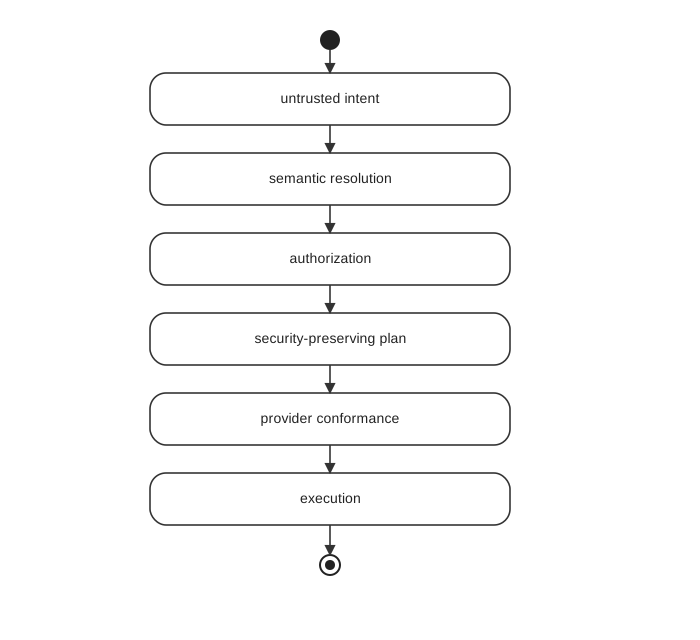
Capability discovery is advisory.
Authentication and identity lifecycle remain application/host responsibilities.
Foundgine.Runtime.ControlPlane (com.foundgine.runtime.controlplane in Java) is optional and outside the core, in both implementations.
Java porting status
The core libraries (foundgine-core, foundgine-runtime, foundgine-providers, foundgine-extensions) and the foundgine-redteam security module are at parity with .NET, verified by matching *ParityTest suites. The Foundgine.SupplyChain.Advanced sample’s OpenIntent-specific tests and MCP-penetration tests are also now at parity (OpenIntentSupplyChainParityTest, OpenIntentMutationSecurityParityTest, AuthorizationMcpPenetrationParityTest). The following are not yet ported to Java:
- the
Foundgine.SupplyChain.Advancedsample’s retrieval-strategy tests (fuzzy/full-text,pg_search/BM25, Apache AGE graph-similarity, and retrieval-capability selection); - the
AgentEndToEndSupply Chain benchmark harness (theSupplyChain.Layeredfixture andRun1–Run5orchestration) — only theHighAssurance.Postgres/TransferFundsbanking fixture has a Java equivalent, underbenchmarks/foundgine-agent; - the standalone
security/pentestmodule (the 14-case GraphQL+MCP PenTest harness).
The advanced sample’s ambiguity-resolution capability (find_top_supplier_overdue_orders) has also been ported, as TopSupplierOverdueOrdersService hand-registered into AdvancedMcpServer, backed by new suppliers/purchase_orders tables in the sample’s Postgres schema. Unlike the rest of that port, this one is unverified against a live database — there is no Postgres available in the environment it was written in, so it has not been run. It also knowingly simplifies one thing versus the C# original: the returned plan fingerprint is a stable hash of the fixed Supplier read shape rather than a real SemanticPlan/ExecutionIRCompiler-derived fingerprint, since wiring that whole chain for one demo capability was out of scope. Treat this port as a draft to verify, not as parity-tested.
What is not claimed
Foundgine does not claim to be:
- a complete autonomous agent platform;
- a universal provider implementation;
- a replacement for ORMs for ordinary persistence;
- an authorization server;
- a workflow/orchestration engine.
Those are intentionally outside the core boundary.
Source of truth
For implementation behavior use:
- active source code (
src/csharp/for .NET,src/java/for Java); - active tests;
- package READMEs under
src/csharp/andsrc/java/; - this documentation.
Historical release notes and benchmark snapshots have been removed from the active documentation set to avoid presenting old behavior as current.
Next: Roadmap