Foundgine
Roadmap
The roadmap is intentionally small. Foundgine’s core boundaries are already established; future work should deepen those boundaries rather than turning the project into a collection of unrelated features.
Current foundation
The following are already implemented and should be treated as the baseline:
- semantic model and open intent;
- semantic resolution/validation/normalization;
- granular semantic authorization;
- conditional authorization predicates;
- immutable semantic contract snapshots;
- provider-independent planning;
- execution IR;
- security-preserving plan rewrites;
- provider security conformance;
- SQL and InMemory providers;
- JSON, GraphQL, MCP and AI adapters;
- AOT metadata generation;
- mutation planning/execution boundaries;
- execution evidence;
- optional authority/recovery package outside the core.
Near term
1. Simplify the public API
Reduce unnecessary ceremony in advanced APIs while preserving the architectural boundaries.
The goal is:
simple common path
        +
explicit advanced path
rather than exposing every internal proof/IR type to ordinary application developers.
2. Strengthen provider composition
Make it easier to implement and compose providers without leaking provider details into semantics/planning.
A new provider should primarily need:
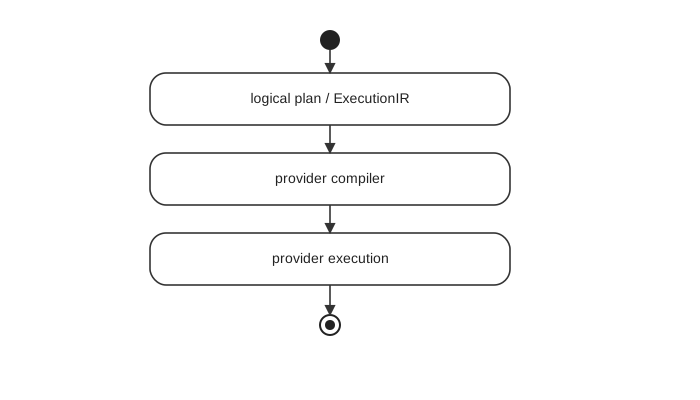
with explicit security conformance.
3. Improve real-world reference applications
Continue using the SupplyChain samples as architecture tests.
The reference applications should show:
- structural metadata;
- application semantic enrichment;
- authorization;
- typed/dynamic intent;
- MCP/GraphQL boundaries;
- mutations;
- PostgreSQL execution.
4. Measure before optimizing
Performance work should be driven by repeatable measurements from the actual provider.
The planner should not accumulate speculative physical optimizations.
5. Keep adapters thin
GraphQL, JSON, MCP, and AI should continue converging on the same semantic/execution contracts instead of developing transport-specific semantics.
Medium term
Potential areas include:
- additional production providers;
- richer semantic expressions where demonstrated use cases require them;
- stronger semantic equivalence/property testing;
- improved operation canonicalization;
- more precise working-vs-output projection semantics;
- broader provider-aware planning evidence;
- stronger mutation ergonomics;
- a temporal candidate kind for lexical grounding (relative/absolute date expressions such as “last summer”), so an expression combining a temporal reference with an otherwise-resolvable entity/field no longer has to fail closed as a whole — see Lexical grounding;
- named value-threshold declarations in the semantic model (e.g. an
AccountTierfield or aHighValueAccountflag) so domain concepts like “big accounts” can be represented in the contract instead of requiring the lexical layer to infer a business-specific cutoff, which it deliberately does not do today.
These should be introduced only when they solve a demonstrated application problem.
Long term / optional
Possible extensions include:
- integrations with external identity/claims systems above the semantic policy boundary;
- more agent-framework adapters;
- additional durable authority/recovery integrations;
- richer event/action semantics.
These are optional extensions, not requirements for the core.
Explicit non-goals
The roadmap does not aim to turn Foundgine into:
- an ORM;
- a GraphQL server;
- an LLM platform;
- an authorization server;
- a workflow engine;
- a general-purpose distributed database.
Roadmap rule
Every new feature should answer three questions:
- Which architectural boundary owns it?
- Can it be implemented without leaking provider/transport details upward?
- What correctness/security test proves it?
If those questions cannot be answered clearly, the feature should not be added yet.
Next: History