Foundgine
Public API
Foundgine’s public API is organized around a small common path with explicit advanced boundaries.
Common application surface
The normal application entry point is IFoundgineExecutor. It deliberately exposes only two ExecuteAsync overloads: one for SemanticRequest and one for ReadIntent. The broader IFoundgine interface is the advanced surface for capability discovery, dry-run, plan approval, and approved execution.
For reads, the main authoring surface is:
foundgine.Query<Customer>()
or:
foundgine.Query("Customer")
The typed and dynamic forms converge on ReadIntent.
Typed query API
TypedQuery<T> supports:
Select
Include
Where
OrderBy
Take
Skip
After
WithSecurity
ToIntent
ExecuteAsync
The current typed filter compiler supports direct property comparisons:
x => x.Id == id
x => x.Name != name
x => x.TenantId == tenantId && x.IsActive == true
More complex semantic predicate algebra belongs in the semantic/planning layers rather than being silently interpreted by the typed convenience API.
Dynamic query API
DynamicQuery supports:
Select
Include
Where
WhereRelated
AndWhere
OrWhere
OrderBy
OrderByPath
Take
Skip
After
WithSecurity
ToIntent
ExecuteAsync
Dynamic names are still resolved against the semantic model.
Semantic intent
The canonical read request is ReadIntent.
It represents caller intent without binding it to:
- SQL;
- GraphQL;
- MCP;
- a specific provider.
Mutation API
IFoundgineMutations is the runtime boundary for mutations.
SemanticMutationIntentBuilder is the open authoring surface:
var graph = new SemanticMutationIntentBuilder(model)
    .Create("Order", "order")
        .Set("CustomerId", customerId)
        .Return("Id")
    .Build();
The builder is not an authorization mechanism.
Application configuration
FoundgineOptions supports:
Model;Metadata;- semantic configuration;
- authorization configuration/policy;
- provider plan cache;
- security warrant services;
- security resource limits;
- execution-time authorization revalidation;
- mutation schema/provider.
Use AddFoundgine(...) for normal DI composition.
Lower-level APIs
Advanced integrations can consume:
Foundgine.Core.Semantic;Foundgine.Core.Semantic.Planning;Foundgine.Core.Execution;Foundgine.Core.Semantic.Metadata;- provider packages.
These expose more of the architecture intentionally.
The lower-level APIs are useful for:
- custom providers;
- custom transport adapters;
- advanced planning;
- tests;
- tooling.
API layering rule
Prefer the highest-level API that solves the application problem.
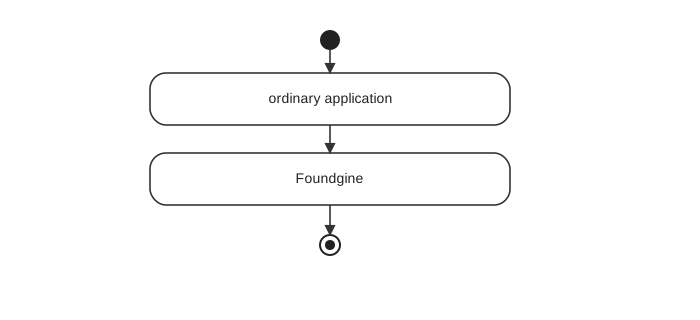
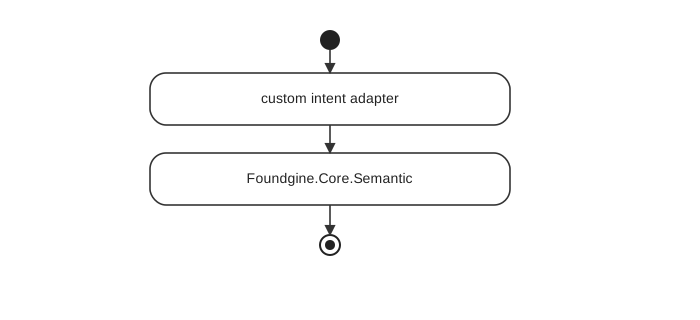
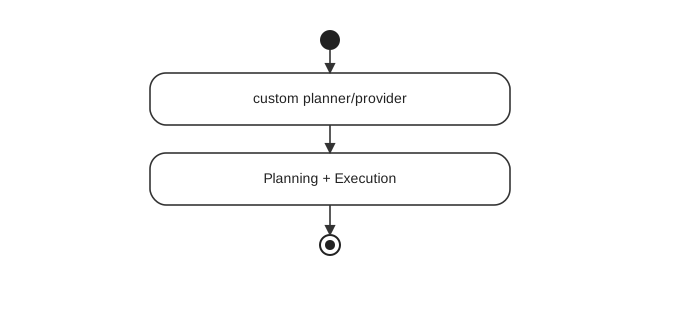
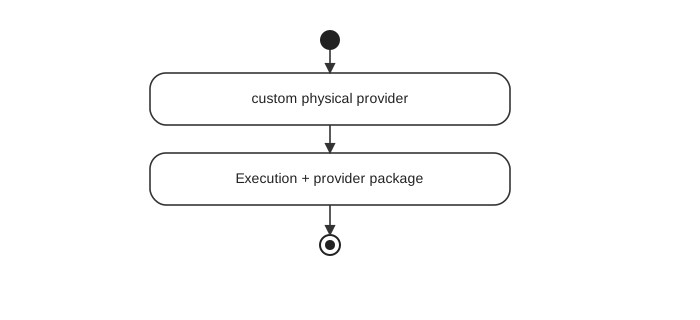
Do not make application code depend on provider internals merely to construct a query.
Security-sensitive APIs
The following concepts should remain explicit rather than hidden:
SecurityExecutionContext;ISecurityExecutionContextProvider;- authorization policy;
- warrant validation;
- replay protection;
- provider security conformance;
- mutation approval/execution boundary.
The public API must not make it easier to accidentally replace trusted context with request data.
Versioning
The repository is currently on the 2.2.1 release line.
The most stable conceptual contracts are:
semantic identity
semantic model
ReadIntent
provider-independent plan
execution/provider boundary
When changing these, update the affected adapter/provider tests rather than adding compatibility shims that blur the architecture.
Where the implementation lives
| Area | Package |
|---|---|
| Facade | Foundgine |
| Contracts/IDs | Foundgine.Core.Abstractions |
| Semantics | Foundgine.Core.Semantic |
| Metadata | Foundgine.Core.Semantic.Metadata |
| Planning | Foundgine.Core.Semantic.Planning |
| Execution | Foundgine.Core.Execution |
| SQL | Foundgine.Providers.Storage.Sql |
| InMemory | Foundgine.Providers.Storage.InMemory |
| AOT | Foundgine.Providers.Aot, Foundgine.Providers.Aot.Generator (build-only analyzer) |
| JSON | Foundgine.Core.Serialization |
| GraphQL | Foundgine.Extensions.GraphQL.HotChocolate* |
| MCP | Foundgine.Providers.Tools.MCP |
| AI | Foundgine.Providers.Models |
| Authority recovery | Foundgine.Runtime.ControlPlane |
Next: AI agents