Foundgine
What Foundgine is designed for
This page exists to answer four questions plainly, in order, before going deeper into architecture: what Foundgine is, how it works at a glance, where it fits in an application, and what it is designed for — followed by the categories of applications the repository already proves it against.
What
Foundgine is a semantic execution boundary for .NET: a layer that sits between “a caller expressed an intent” and “a provider executed something,” and makes sure the second never happens without the first being resolved against application-defined meaning and authorized against the caller’s actual permissions.
It is not a database, an ORM, a GraphQL server, an identity provider, a workflow engine, or an autonomous agent framework. See Why Foundgine for the full contrast.
How
At a glance, every caller — application code, GraphQL, JSON, MCP, an AI agent — converges on the same pipeline:
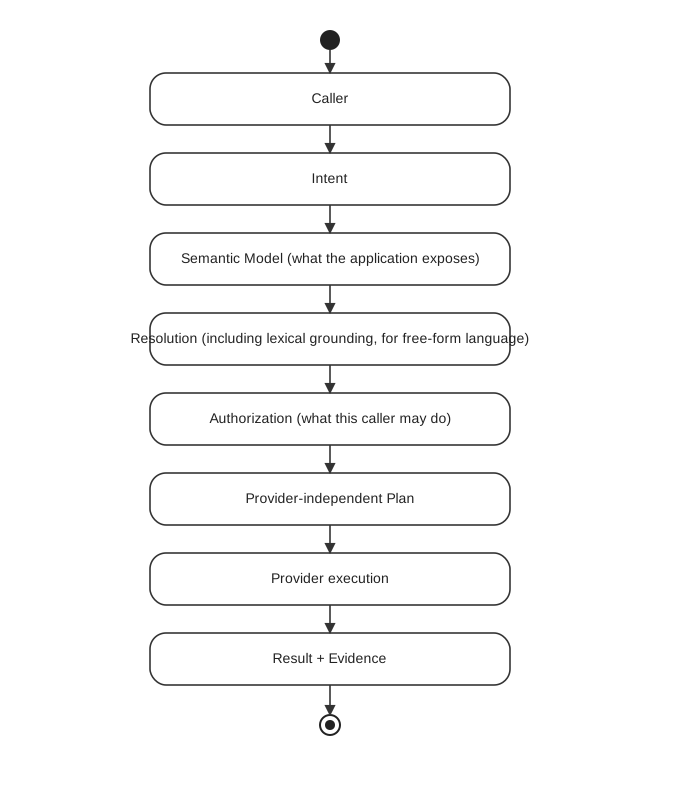
The application defines what exists and what is allowed once. Every caller-facing surface reuses that same decision instead of re-implementing it. See Architecture for the full lifecycle.
Where
Foundgine sits below the transport, above the provider:
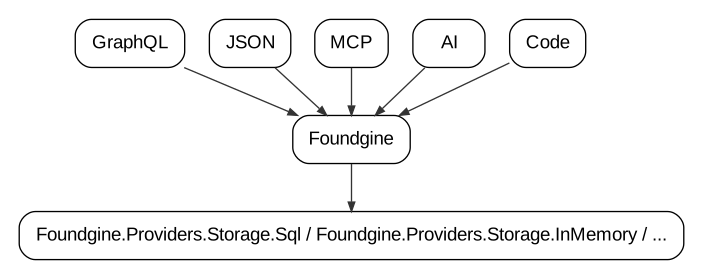
Concretely, that means:
- it replaces the layer where a controller, resolver, or tool handler would otherwise hand-roll authorization checks, tenant filters, and query construction;
- it does not replace the provider underneath —
Foundgine.Providers.Storage.Sqlstill talks to PostgreSQL,Foundgine.Providers.Storage.InMemoryis a proof/test provider, and nothing stops an application from also using an ORM for ordinary CRUD persistence alongside it; - it does not replace the transport in front — GraphQL, MCP, and JSON adapters remain thin translations into Foundgine’s semantic intent, not separate execution architectures.
What it’s designed for
Foundgine is designed for applications where more than one kind of caller needs to reach the same data and operations, and the cost of one of them getting authorization or meaning wrong is real. The value is small when there is exactly one caller and one hand-written path to the database. It grows with:
- the number of distinct callers (endpoints, tools, transports) that would otherwise each reimplement authorization and query construction;
- how consequential a wrong or under-authorized operation would be (a report is cheap to get wrong; a funds transfer is not);
- how much of the caller’s input is free-form language rather than a fixed, pre-validated shape.
It is explicitly not designed to let a model infer business policy, choose an interpretation on the caller’s behalf when the words are genuinely ambiguous, or grant execution authority based on generated intent. See Grounding decisions for how that boundary is enforced even inside free-form language resolution.
Categories of applications
The samples in this repository are not arbitrary demos — each one is the proof case for a distinct category of application Foundgine targets.
1. Multi-transport enterprise backends
One hardened semantic and authorization core exposed through several transports at once (GraphQL, MCP, JSON), so each transport adapter stays a thin translation instead of its own security surface.
src/csharp/samples/Foundgine.SupplyChain— the minimal MCP → application → semantic model → planning → SQL → PostgreSQL starter.src/csharp/samples/Foundgine.SupplyChain.Advanced— the full semantic proving ground for Metadata → Semantics → Authorization → Intent, including lexical grounding, ambiguity handling, retrieval strategies and adversarial tests.src/csharp/benchmarks/AgentEndToEnd/Fixtures/SupplyChain.PenTest— benchmark-only transport security regression coverage over GraphQL and MCP.
2. AI-agent tool execution boundaries
An agent (or any LLM-driven caller) proposes structured intent; Foundgine remains the authority over what that intent means and whether it is authorized, so a growing tool surface does not become a growing set of independent, inconsistently-secured execution paths.
src/csharp/samples/Foundgine.SupplyChain— the starter agent-facing MCP surface.src/csharp/samples/Foundgine.SupplyChain.Advanced— the same boundary at full application and semantic complexity.
See AI agents for the boundary this draws in detail.
3. High-assurance mutation workflows
Writes where the cost of a wrong authorization decision is high enough to justify explicit dependency ordering, replay protection, deterministic locking, and an execution receipt — deliberately not inferred from natural language.
src/csharp/benchmarks/AgentEndToEnd/Fixtures/HighAssurance.Banking— aTransferFundsmutation whose execution boundary revalidates tenant, ownership, account state, and daily limits, and produces an audit entry and receipt.src/csharp/benchmarks/AgentEndToEnd/Fixtures/HighAssurance.Postgres— the same capability against real PostgreSQL execution, transaction, and idempotency semantics.
4. Composite / cross-domain application models
Applications whose semantic model doesn’t map 1:1 onto a single physical schema — meaning is assembled from multiple underlying concepts, and the semantic layer is what makes that assembly explicit instead of implicit in query code.
src/csharp/samples/Foundgine.SupplyChain.Advanced— its application-facing semantic model is explicitly separated from persistence/storage concepts.
5. Free-form / natural-language query surfaces
Callers that describe what they want in ordinary language rather than a fixed request shape — a search box, a chat interface, an agent without a rigid tool schema. This is the category lexical grounding and grounding decisions exist for: turning free text into a semantic interpretation without letting retrieval relevance become authorization, and without letting a structurally valid path stand in for a correctly understood one.
src/csharp/Foundgine.Providers/Foundgine.Providers.Storage.Elasticsearch,src/csharp/Foundgine.Providers/Foundgine.Providers.Storage.PostgresVector— the two optional candidate-retrieval providers for this category.src/csharp/samples/Foundgine.SupplyChain.Advanced/Semantic/Tests/Grounding— a worked example of a materially ambiguous business term (active supplier) against a real generated semantic contract.
These categories are not mutually exclusive — the two SupplyChain samples alone touch categories 1, 2, and 5 at once. They are meant as a map of why a given piece of architecture exists, not a menu of separate products.
Previous: Why Foundgine · Next: Architecture