Foundgine
Open Intent API
Foundgine’s intent surface is deliberately open. Applications expose a semantic model and authorization policy; callers do not need a pre-generated method or interface for every possible query.
Open intent enters the canonical lifecycle
Typed, dynamic, JSON, MCP, GraphQL and AI callers all converge on the same semantic lifecycle after producing intent:
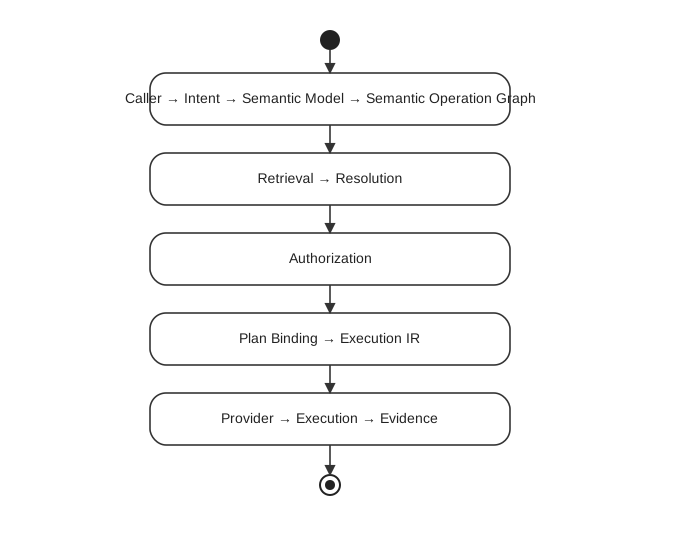
Typed and dynamic authoring
Typed authoring gives developers compile-time help:
var result = await foundgine
    .Query<Customer>()
    .Select(c => new { c.Id, c.Name })
    .Where(c => c.TenantId == tenantId)
    .ExecuteAsync();
Dynamic authoring is intended for agents, MCP, JSON adapters, and other callers that discover the model at runtime:
var result = await foundgine
    .Query("Customer")
    .Select("Id", "Name")
    .ExecuteAsync();
Both produce the same ReadIntent and therefore use the same resolution, authorization, planning and provider execution pipeline.
Logical traversals
A semantic model may expose a logical traversal without pretending that it is a physical relationship.
For example, a model can define:
Customer
  -> CustomerRelationship
  -> Contract
  -> Transaction
and expose the open-intent traversal transactions:
.Traversal(
    Customer,
    "transactions",
    CustomerRelationships,
    RelationshipContract,
    ContractTransactions)
A dynamic caller can then ask for:
foundgine.Query("Customer")
    .Select("Id")
    .Include("transactions", transactions =>
        transactions.Select("Id", "Amount"));
Foundgine expands the logical traversal before authorization:
Customer
  -> CustomerRelationship
      -> Contract
          -> Transaction
The caller does not need to know those intermediate entities. The security system does.
Security rule
A logical traversal never bypasses intermediate semantics. Entity policies, relationship policies, field visibility, row predicates and execution invariants remain attached to the expanded nodes and edges.
If access to Contract is denied, Customer.transactions cannot tunnel through it to expose Transaction.
Logical traversals are also included in semantic model versioning, so changing a route invalidates stale plan approvals and cache identity.
Dynamic filters and ordering
Dynamic intent can compose filters and relationship filters:
foundgine.Query("Customer")
    .Select("Id", "Name")
    .Where("TenantId", SemanticFilterOperator.Eq, tenantId)
    .WhereRelated(
        "transactions",
        SemanticRelationshipQuantifier.Some,
        transactions => transactions.Where("Amount", SemanticFilterOperator.Eq, 100));
A logical traversal used as a relationship filter is expanded into its real relationship chain before semantic validation. Multi-hop None/All quantification is intentionally rejected until the semantic algebra has an explicit path-quantifier representation; Foundgine must never silently produce a logically different query.
Open mutations
Mutations use the same principle but are deliberately more explicit because they can change state.
SemanticMutationIntentBuilder lets a developer compose an open mutation graph by semantic names while retaining generated-value dependencies:
var graph = new SemanticMutationIntentBuilder(model)
    .Create("PurchaseOrder", "order")
        .Set("SupplierId", supplierId)
        .Return("Id")
    .Create("PurchaseOrderLine", "line")
        .SetFrom("PurchaseOrderId", "order", "Id")
        .Set("ProductId", productId)
        .Set("Quantity", 25m)
        .Return("Id", "PurchaseOrderId")
    .Create("Shipment", "shipment")
        .SetFrom("PurchaseOrderId", "order", "Id")
        .Set("Quantity", 25m)
        .Return("Id")
    .Build();
This produces the same SemanticMutationOperationGraph consumed by the existing mutation planner, authorization layer and execution security gate. The builder does not know about SQL columns, transactions, provider-generated correlation carriers or storage implementation.
For high-assurance mutations, callers should still use the normal mutation execution boundary. The builder is an authoring convenience; it is not an authorization bypass.
Design rule
Open intent describes what callers may ask for. The semantic model describes what exists and how it connects. Authorization determines what the caller may actually use. Planning determines how the authorized meaning can execute.
The application therefore does not need to predict every future query or mutation while retaining a single authoritative security and execution pipeline.
Next: Lexical grounding